The OODA Loop
A Practical Framework for Better Anesthesia Leadership

Anesthesia professionals are trained to make decisions in environments that are constantly changing. We observe the patient, interpret what we are seeing, decide what needs to happen next, act, and then reassess as new information becomes available.
A blood pressure changes, oxygen saturation begins to fall, surgical conditions shift, or a medication produces a different response than expected. We do not make one decision and assume the work is finished. We continue gathering information, evaluating the patient’s response, and adjusting the plan as the situation evolves.
In many ways, anesthesia is already an OODA loop.
The OODA loop is a decision-making framework built around four steps: Observe, Orient, Decide, and Act. The concept was developed by United States Air Force Colonel John Boyd to describe how individuals and organizations operate in fast-moving and uncertain environments. Although it originated in military strategy, it applies remarkably well to clinical anesthesia, healthcare operations, and leadership.
The most important word in the framework may not be observe, orient, decide, or act. It may be loop.
The process does not end after a decision is made or an action is taken. Once we act, we observe the result, reorient ourselves based on the new information, make the next decision, and act again. Each cycle should improve our understanding of the situation and move us closer to the desired outcome.
This continuous iteration is central to good clinical care, but it is often underused in leadership. Too many leaders believe they must develop the perfect answer before moving forward. They continue gathering information, requesting additional analysis, and revisiting the same questions because they fear making the wrong decision.
That pursuit of perfection can easily become analysis paralysis.
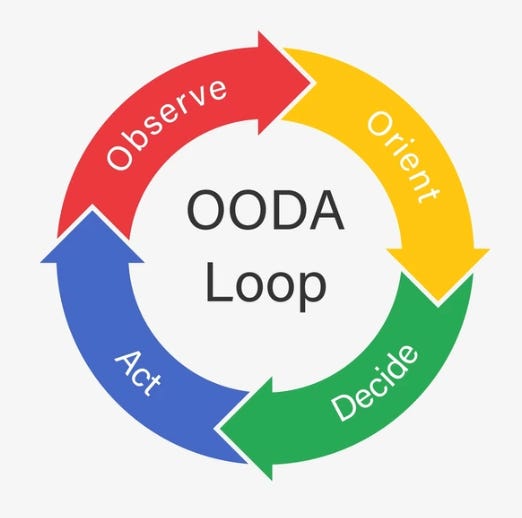
The OODA loop offers a different approach. Rather than waiting for certainty that may never come, leaders can make the best reasonable decision based on the information currently available, implement it thoughtfully, evaluate the result, and make incremental improvements through each successive cycle.
That is not careless decision-making. It is disciplined adaptability.
Observe
The first step is to collect accurate and relevant information.
In clinical anesthesia, observation includes the patient’s medical history, physical examination, monitors, laboratory results, surgical procedure, blood loss, medication responses, communication from the operating room team, and the subtle changes that experienced clinicians often recognize before a monitor begins alarming.
Strong clinicians do not focus on only one number or data point. They develop situational awareness by continuously evaluating the entire clinical environment and considering how each new piece of information fits within the larger picture.
Leadership requires the same discipline.
Leaders must observe operational performance, staffing patterns, financial results, clinician engagement, facility relationships, quality outcomes, recruiting trends, market conditions, and feedback from the people closest to the work. They must also pay attention to what is not being said, particularly when silence may indicate frustration, uncertainty, or disengagement.
The challenge is that leadership feedback is rarely as immediate or precise as clinical feedback. When a vasopressor is administered, the physiologic response may be visible within seconds. When a leader changes a staffing model, communication process, compensation structure, or organizational design, the effects may not become clear for weeks or months.
That delay makes reliable observation even more important. Leaders must create monitoring systems that allow them to recognize trends before small issues become major problems. Scorecards, operational calls, financial reports, one-on-one meetings, clinician surveys, and facility feedback are not merely administrative exercises. They are the organizational equivalent of clinical monitors.
Without dependable information, leaders are attempting to manage a complex organization without being able to see its vital signs.
At the same time, observation should not become an excuse to delay indefinitely. There will always be another report that could be requested, another perspective that could be gathered, or another scenario that could be modeled. The goal is to obtain enough reliable information to understand the issue and make a reasonable decision, not to eliminate every possible uncertainty.
Orient
Orientation is where we interpret what we have observed and place it within the context of our knowledge, experience, assumptions, culture, and current environment.
Two clinicians may observe the same blood pressure and interpret its significance differently because they understand the patient, procedure, and clinical context differently. The number itself matters, but its meaning depends on the larger situation.
The same is true in leadership.
A decline in surgical volume may reflect a temporary seasonal trend, a surgeon departure, operational dissatisfaction, changing payer mix, or a broader shift in the local market. A staffing shortage may be caused by compensation, scheduling, leadership, culture, workload, recruiting processes, or several of those factors working together.
The data tells us what is happening. Orientation helps us understand why it may be happening and what the information means for the organization.
This is also where leaders must challenge their assumptions. One of the greatest risks in both anesthesia and leadership is becoming anchored to the original diagnosis or plan after the situation has changed. We may continue treating what we expected to happen rather than responding to what is actually occurring.
Strong leaders remain curious. They ask whether the initial interpretation is still accurate, seek input from people closer to the work, and remain willing to change their perspective when new information emerges.
The iterative nature of the OODA loop is particularly valuable here. We do not have to perfectly understand every aspect of a complex problem during the first cycle. We can develop the best interpretation available, act on it, and then use the response to improve our understanding during the next cycle.
Every action creates additional information.
A new scheduling process may reveal that the primary problem was not scheduling technology but unclear ownership. A compensation adjustment may improve recruiting but have little effect on retention, suggesting that culture or workload is the larger issue. A new operational call structure may expose gaps in reporting or role clarity that were previously difficult to see.
The first cycle rarely provides the complete answer, but it should help us ask better questions in the next one.
Decide
Once we have observed the situation and oriented ourselves to its meaning, we must make a decision.
In anesthesia, perfect information is rarely available. We make the best decision possible based on what we know at that moment, understanding that we may need to adjust quickly as the patient responds or the clinical situation changes.
Leadership is no different, yet leaders often hold themselves to an unrealistic standard. They believe the first decision must be the final decision and that changing course later will make them appear uncertain or ineffective.
That mindset creates unnecessary pressure and often delays action.
The purpose of the OODA loop is not to guarantee that the first decision will be perfect. Its purpose is to create a process through which decisions become progressively better as information and experience accumulate.
A strong leader should aim to make the best available decision, not wait indefinitely for the perfect decision.
That distinction matters. The best available decision is grounded in sufficient information, aligned with organizational goals, proportionate to the risk involved, and capable of being evaluated after implementation. It accepts that some uncertainty remains and builds reassessment into the process.
Leaders should also distinguish between reversible and irreversible decisions. A reversible decision can often be made more quickly, tested on a smaller scale, and modified based on the results. A major acquisition, long-term contract, or significant restructuring requires more analysis because the consequences are more difficult to reverse.
Not every issue should move through the loop at the same speed.
However, even major decisions should not become trapped in endless analysis. At some point, the cost of delay becomes greater than the risk of moving forward. Staffing gaps remain open, facility relationships deteriorate, employees lose confidence, opportunities disappear, and problems become more expensive.
Making no decision is still a decision, and it often carries consequences that are less visible but equally real.
Act
A decision has little value until it results in action.
Organizations are filled with good ideas that never become operational reality. Meetings occur, recommendations are made, and general agreement is reached, but responsibility remains unclear and very little changes.
Effective action requires ownership, timelines, resources, communication, and accountability. People need to understand what will happen next, who is responsible, when it should be completed, and how the result will be measured.
In anesthesia, we do not simply decide that the patient needs additional blood pressure support. Someone administers the medication, adjusts the anesthetic, gives fluid, communicates with the surgeon, or takes another appropriate action.
Leadership must be equally clear.
The Board sets strategic direction. Executive leadership translates that direction into organizational priorities. Managers create the processes and accountability required for execution. Team members perform the work and provide feedback about what is and is not working. Each level has an important role, and the OODA loop is strongest when information and decision-making move effectively across all of them.
Action does not always need to involve a large, organization-wide initiative. In fact, incremental changes are often more effective because they allow the organization to learn without creating unnecessary disruption.
A leader may pilot a new workflow at several sites before expanding it across the enterprise. A team may test a revised scorecard for one quarter before finalizing the measures. A manager may adjust meeting frequency, clarify responsibilities, or delegate a new category of decisions and then evaluate whether performance improves.
Small actions, when followed by honest reassessment, can produce meaningful progress over time.
The Loop: Reassess, Learn, and Improve
After taking action, the process begins again.
We observe the result. We evaluate what changed. We consider whether the action produced the intended outcome, created an unintended consequence, or revealed something we did not previously understand.
Then we reorient, decide, and act again.
This is where the OODA loop becomes much more than a four-step decision tool. It becomes a model for continuous improvement.
The first action may solve part of the problem but not all of it. It may work in one setting but require modification in another. It may produce an early improvement that fades over time. Rather than viewing these outcomes as failure, leaders should treat them as information that improves the next cycle.
The goal is not to defend the original decision. The goal is to improve the outcome.
This can be difficult because leaders naturally become invested in the strategies they developed. Once time, money, and personal credibility have been committed, changing direction can feel like admitting the original decision was wrong.
The OODA loop reframes adjustment as a sign of effective leadership rather than weakness. A leader who changes course based on new evidence is not indecisive. A leader who refuses to change despite new evidence may be.
Continuous iteration also reduces the pressure to design the perfect solution before implementation. When leaders know that the decision will be reviewed and improved, they can move forward with appropriate confidence rather than waiting for impossible certainty.
We believe this scheduling process will reduce open shifts, so we implement it, measure the results, and refine it.
We believe this operational structure will improve accountability, so we clarify roles, observe performance, and make adjustments where needed.
We believe this compensation model will improve recruitment and retention, so we track both outcomes rather than assuming the initial design will work equally well everywhere.
Each cycle should move the organization closer to the desired future state.
Progress often comes from many small corrections rather than one brilliant decision.
Building an Organization That Can Learn
One of the challenges for clinicians moving into leadership is that organizational feedback is slower, less direct, and influenced by far more variables than clinical feedback.
That can be frustrating for people who are accustomed to making an intervention and quickly seeing whether it worked.
Leadership requires us to become comfortable with delayed information while still creating mechanisms for timely learning. It also requires us to build teams capable of moving through their own OODA loops rather than sending every decision upward.
The strongest leader is not necessarily the person who makes the most decisions. It is often the person who creates clarity, develops others, and places decision-making authority at the appropriate level.
When people have reliable information, clear expectations, the necessary skills, and appropriate authority, the organization can observe, orient, decide, and act much faster. Leaders can then focus less on personally solving every problem and more on improving the systems through which problems are recognized and resolved.
In that sense, leadership is not about completing every OODA loop yourself. It is about creating an organization that learns and improves through thousands of well-executed loops occurring at every level.
Final Thought
Anesthesia teaches us that a good plan is important, but no plan survives unchanged once the clinical environment begins to evolve. We act based on the best information available, evaluate the response, and adjust as needed.
Leadership should work the same way.
The goal is not to make the perfect decision on the first attempt. The goal is to make a thoughtful decision, act with clarity, learn from the result, and continue making incremental improvements.
Leaders who understand the loop are less likely to become paralyzed by uncertainty because they know that action is not the end of the process. It is the beginning of the next cycle.
The environment will continue to change. New information will emerge. Some decisions will work as intended, while others will require refinement. What matters is our ability to keep observing, learning, deciding, and improving.
Observe. Orient. Decide. Act. Then use what you learned to do it better the next time.
"The most important word may be loop" is the part I would defend hardest, and the delay you name is exactly what makes it hard to run in leadership. At the head of the bed I get my answer in seconds, so I can afford to be wrong often and correct fast, which is the whole reason the clinical loop feels natural to us. A staffing model does not report back for a quarter, and at that sampling rate you often cannot tell "this was the wrong call" from "this was right and we stopped too early." The only fix I have seen work is putting the reassessment date into the decision itself, before anyone is invested in defending it. And the line I would put on a wall is that making no decision is still a decision. I have watched a room wait for a number to declare itself, and the waiting was the intervention.